Most people's first mac and cheese came from a box. Powdered cheese, boiling water, done in five minutes. Nothing wrong with that — but it's a completely different dish from what mac and cheese is actually supposed to be.
Real homemade mac and cheese starts with a béchamel — a proper French white sauce built on a roux. That sauce is what gives baked mac and cheese its richness, its body, and the depth that powdered cheese can never replicate. Lucky Cajun Black Label goes into the sauce itself so the Cajun flavor carries through every bite rather than just sitting on the surface.
This is the version worth making.
A Brief History of Mac and Cheese in America
Thomas Jefferson is widely credited with helping popularize baked macaroni and cheese in America after encountering it during his time in France. The dish is unmistakably French in origin — a pasta baked in béchamel sauce in an au gratin dish — but it became something distinctly American over the centuries that followed.
Today mac and cheese exists in countless variations from boxed to gourmet. The foundation is always the same. A proper sauce built correctly is everything.
Why This Works
The roux is the foundation. Oil and flour cooked together before the milk goes in creates a stable emulsified sauce that doesn't break when the cheese is added. Adding cold milk to a dry roux produces lumps. Warm milk added gradually produces a smooth silky béchamel.
Adding cheese one handful at a time while stirring constantly prevents clumping and ensures the cheese melts evenly into the sauce rather than seizing into stringy clumps.
Bay leaf and nutmeg in the béchamel are the classic French additions that add subtle depth without announcing themselves. They make the sauce taste more complex without tasting like anything specific.
Lucky Cajun Black Label in the sauce — not just on top — means the seasoning distributes through every pasta piece and every spoonful of sauce. Fresh ground seasoning added to a hot béchamel blooms into the milk and builds a savory Cajun depth that carries through the entire bake.
Undercooking the pasta slightly before baking is non-negotiable. Pasta that goes into the oven fully cooked comes out overcooked and mushy. Al dente pasta absorbs the sauce during baking and finishes at the right texture.
Seasoning freshness is the most overlooked part of cooking. Most of what's in your cabinet was ground over a year ago — the flavor's already gone, and nothing on the jar tells you when it was made. Every Lucky Cajun bag is stamped with the date it was ground. Nobody else in the US does that. Browse our fresh ground seasoning collections → Satisfaction guaranteed.
Ingredients
- 1 lb bite-sized pasta — elbows, shells, or penne
- 4 tbsp oil
- 3 tbsp flour
- 1 bay leaf
- ½ small onion, finely diced
- Pinch of nutmeg
- 1 tbsp fresh ground Lucky Cajun Black Label seasoning
- 2½ cups whole milk, warmed
- 18 oz shredded cheese — Gruyère, sharp cheddar, or a mix
- ½ cup buttered breadcrumbs for topping if baking
Instructions
1. Cook the Pasta
Boil pasta in well-salted water until just shy of al dente. If baking, undercook it slightly — it will absorb the sauce and soften in the oven. Drain and set aside.
2. Make the Béchamel
Heat oil in a pan over medium heat. Add finely diced onion and cook until soft but not caramelized. Stir in flour to form a roux and cook for about a minute, stirring constantly.
Slowly whisk in the warmed milk, adding half at a time and whisking until fully incorporated before adding more. The sauce should thicken smoothly without lumps.
Add bay leaf, nutmeg, and Lucky Cajun Black Label. Simmer for a few minutes until the sauce has developed body and the seasoning has bloomed into the milk.
3. Add the Cheese
Remove the bay leaf. If baking reserve half the cheese for the topping.
Add shredded cheese one handful at a time, stirring continuously between each addition. Don't rush this step — adding too much cheese at once causes it to clump and seize. Steady additions with constant stirring produce a smooth glossy sauce.
For extra saucy mac and cheese add an additional ½ cup of warm milk.
4. Assemble and Bake
Stir the cooked pasta into the cheese sauce until evenly coated.
For stovetop mac and cheese — it's ready to serve immediately.
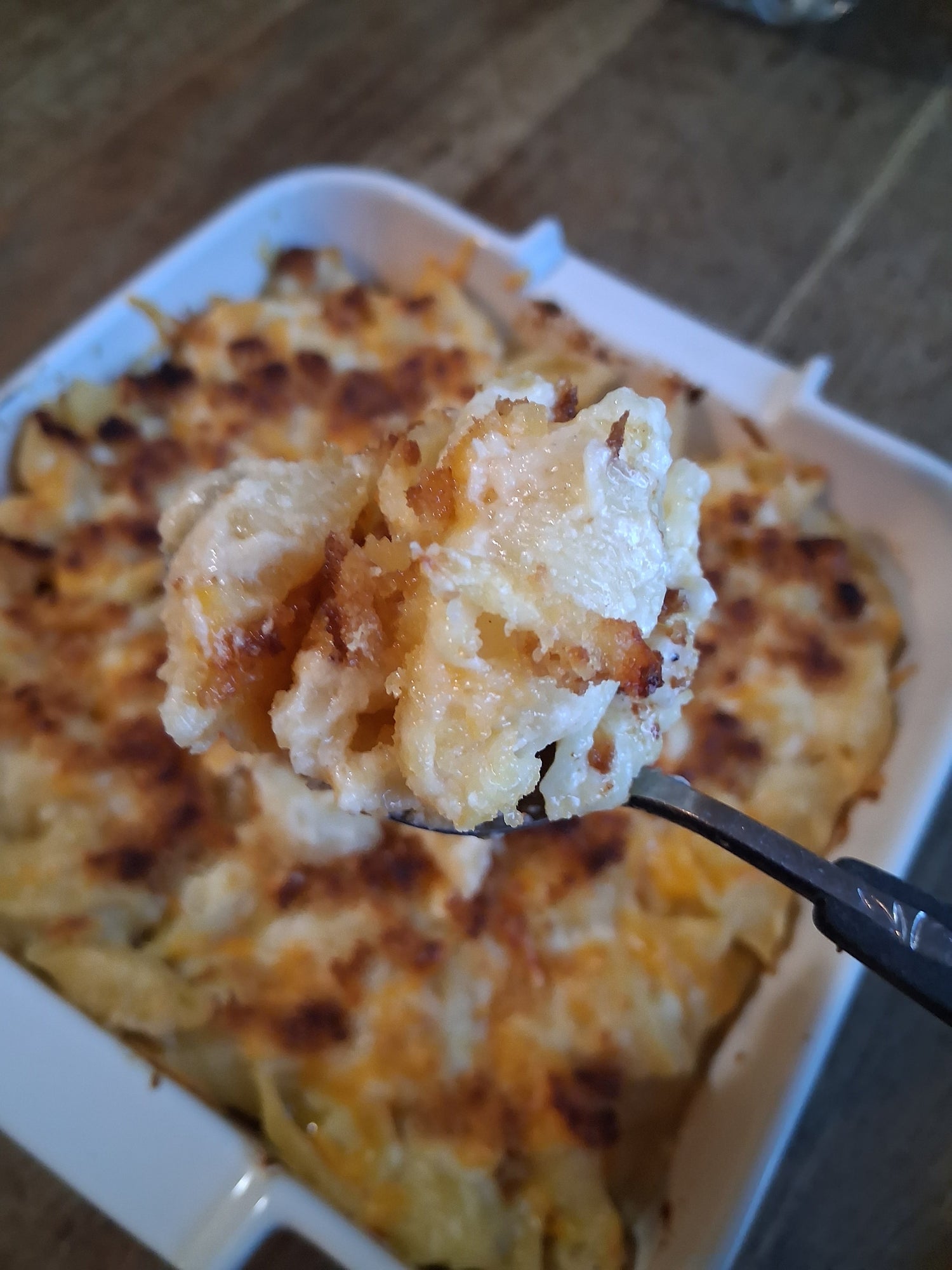
For baked mac and cheese — transfer to a greased baking dish. Top with reserved shredded cheese and buttered breadcrumbs. Bake at 375°F for 25 minutes until bubbly and golden. Broil for 1 to 2 minutes at the end for a deeply golden crispy top.
Make It Your Own
Mac and cheese is a flavor vessel. The béchamel base works with almost any addition:
- Blackened chicken seasoned with Black Label
- Crawfish tossed in Voodoo
- Andouille or smoked sausage
- Ground beef with Taco Tuesday seasoning
- Sautéed mushrooms with Lucky Lemon Dilly Pepper
- Peas, asparagus, or roasted vegetables
- Extra cheese — always
The Cajun mac and cheese version — Lucky Cajun Black Label in the sauce with blackened chicken or crawfish mixed in — is the version that makes people ask for the recipe.
Variations With Other Lucky Cajun Blends
Cajun shrimp mac and cheese: Season shrimp with Voodoo right before searing in butter over high heat. Pull immediately and fold into the finished mac and cheese before baking. The habanero heat in Voodoo cuts through the richness of the béchamel perfectly.
Smoky version: Add a pinch of Lucky Cajun Black Beard's Smoke to the béchamel alongside Black Label for a deeper smokier mac and cheese that pairs naturally with andouille or smoked sausage.
Spicier version: Add fresh ground Lucky Cajun Fiery Datil to the sauce for a fruity citrusy heat that builds through every bite. Unexpected in mac and cheese and completely right.
Salt-free version: Use Lucky Cajun Salt-Free Original in place of Black Label for a lower sodium build without losing the fresh ground Cajun depth. Useful since cheese and pasta water both add significant salt.
FAQ
What makes homemade mac and cheese better than boxed?
A proper béchamel sauce built on a roux produces a rich creamy texture that powdered cheese simply can't replicate. Real shredded cheese melted into a fresh sauce has depth, body, and flavor that is fundamentally different from reconstituted cheese powder.
What is a béchamel sauce?
A French white sauce made by cooking flour in fat to form a roux, then whisking in warm milk until smooth and thickened. It's the foundation of mac and cheese, lasagna, and countless other dishes. Getting it right is the key technique in this recipe.
Why warm the milk before adding it to the roux?
Cold milk added to a hot roux creates lumps and slows the thickening process. Warm milk incorporates smoothly and produces a lump-free béchamel in a fraction of the time.
Why add cheese one handful at a time?
Adding too much cheese at once causes it to clump and seize into stringy masses instead of melting smoothly into the sauce. One handful at a time with constant stirring produces a glossy emulsified cheese sauce.
Why undercook pasta before baking mac and cheese?
Pasta continues cooking in the oven as it absorbs the cheese sauce. Starting with fully cooked pasta produces overcooked mushy pasta in the finished dish. Al dente pasta that still has slight resistance finishes at the perfect texture after baking.
What is the best cheese for homemade mac and cheese?
Gruyère melts exceptionally well and adds a nutty depth. Sharp cheddar adds assertive flavor. A combination of both produces the best of both worlds. Avoid pre-shredded bags with anti-caking agents that prevent proper melting.
What is the best Cajun seasoning for mac and cheese?
A fresh ground sugar free Cajun seasoning added directly to the béchamel so it distributes through the entire sauce. Lucky Cajun Black Label builds a savory Cajun depth that carries through every bite without overpowering the cheese.
Can I make mac and cheese ahead of time?
Yes. Assemble completely, cover, and refrigerate unbaked for up to 24 hours. Add 5 to 10 extra minutes of bake time since it's starting cold. The sauce may need a splash of warm milk stirred in before baking if it has thickened in the refrigerator.
What pasta shape works best for mac and cheese?
Bite-sized shapes with ridges or curves that hold sauce — elbows, shells, cavatappi, or penne. Avoid long pasta that doesn't distribute evenly through the sauce.
How do you get a crispy top on baked mac and cheese?
Buttered breadcrumbs mixed with reserved shredded cheese on top. Bake at 375°F until bubbling then broil for 1 to 2 minutes watching closely. The broiler takes the top from golden to burnt in under a minute so don't walk away.
Why Lucky Cajun
Seasoning a béchamel requires seasoning that blooms into hot liquid and distributes evenly through the sauce. Fresh ground Black Label with volatile oils still active builds Cajun depth into the milk during the simmer — not just on the surface. Every Lucky Cajun bag ships with a Born-On Date so you know the seasoning is still working when it goes into the sauce.
🌶️ Shop Lucky Cajun Black Label
🌶️ Shop Lucky Cajun Voodoo
🌶️ Shop Lucky Cajun Black Beard's Smoke
🌶️ Shop the Best Sellers 4-Pack
Build the roux properly. Warm the milk. Add cheese one handful at a time. Undercook the pasta.
That's homemade mac and cheese done right. 🌶️